You top up the oil in your car. You refill the water in your iron. So when the fridge starts cooling badly, “it just needs gas” feels like the obvious answer — and plenty of street-side “technicians” in Dubai are happy to take your money for exactly that. Here is the uncomfortable truth from more than a decade of repairing refrigerators across the city: refrigerator gas refilling in Dubai is real work, but it is almost never the whole job. Refrigerant runs in a permanently sealed loop. If the charge is low, the gas escaped somewhere — and topping it up without finding the leak is like refilling a punctured tyre without plugging the hole.
In this guide I’ll show you the genuine signs a fridge needs a gas top-up, why refrigerant “runs out” at all, exactly what a professional refilling should include, what it should cost in Dubai in 2026, and the red flags that separate real technicians from the ones who will be back at your door next month for the same “refill”.

Why a refrigerator never “uses up” its gas
Refrigerant (modern fridges use R600a isobutane or R134a) is not a consumable like fuel. It circulates in a closed copper/aluminium loop: the compressor squeezes the gas, the condenser releases the heat into your kitchen, the refrigerant expands through the capillary tube, and the evaporator inside the freezer absorbs heat from your food. Then it goes around again — for the life of the appliance.
Nothing in that cycle consumes the gas. So when a technician opens the service valve and finds the pressure low, physics has only one explanation: the refrigerant leaked out. That reframes the whole job. “Gas refilling” is not a maintenance task like an AC service — it is the final step of a leak repair. Any refill that skips the leak-hunt is renting you a working fridge for a few weeks, not fixing it.
This is also why the question “how often should I refill fridge gas?” has a boring answer: never, ideally. A sealed system that was correctly charged in the factory can run 15+ years without losing a gram. Dubai’s reality — hard water humidity, coastal salt air in Marina/JBR, constant vibration from building mechanical rooms, and compressors labouring through 45°C summers — simply makes leaks more common here than in milder climates.
7 signs your fridge may need a gas top-up (and a leak check)
- Slow, steady cooling loss. Not a sudden death — the fridge gets a little worse every week. That gradual slide is the classic low-charge signature, because the remaining refrigerant still works, just less effectively.
- Freezer partially frozen, fridge warm. The evaporator’s first coil section still gets cold while later sections starve — the pattern when charge is marginal.
- Compressor running almost non-stop. Low charge means poor heat absorption, so the compressor rarely cycles off. Your DEWA bill quietly climbs first.
- Uneven frost pattern. On a healthy evaporator, frost spreads evenly. A low charge frosts only the first stretch of tubing and leaves the rest clean.
- Oily residue at pipe joints or the back panel. Refrigerant circulates with a trace of compressor oil; where gas escapes, oil mist often leaves a tell-tale stain.
- Hissing or gurgling you didn’t hear before. Gas moving through a leak point can hiss audibly — often loudest right after the compressor stops.
- Water pooling inside. Weak cooling lets the defrost drain ice up, so meltwater overflows into the cabin. (Though leaks of the water kind have other causes we cover in our refrigerator repair guide.)
One caution before you blame the gas: a fridge that runs constantly can also have dirty condenser coils, a worn door gasket, or a faulty thermostat — all cheaper fixes than a sealed-system repair. Our post on why a refrigerator stops cooling walks through those look-alike faults.
How refrigerant actually escapes in Dubai apartments and villas
After thousands of jobs, the leak sources repeat themselves:
- Vibration fatigue. A compressor that isn’t sitting level shakes its own pipe joints for years until a braze or flare cracks. Very common after a fridge has been moved without proper transport.
- Corrosion of the evaporator or condenser. Coastal humidity plus kitchen cleaning chemicals attack aluminium fins and steel tubing, eventually pinholing them.
- Defrost-heater punctures. Someone chiselling ice off a freezer shelf slips and drills into the evaporator plate — instant leak, and honestly one of the most frequent self-inflicted failures we see.
- Factory joints and lockports. A small number of units leave the factory with a weak braze that fails in year 2–4.
Point three deserves a public-service note: never chip ice with a knife or screwdriver. If your frost-free freezer ices up, the defrost system needs repair, not a weapon.

What a professional refrigerator gas refilling in Dubai must include
A proper refill is a sealed-system repair procedure, not a five-minute top-up. When our technicians open a low-charge fridge, this is the sequence that actually fixes the problem:
- Leak detection first. We pressurise the loop with dry nitrogen and check every joint with an electronic leak detector and bubble solution. Finding the exact escape point is the whole point of the visit.
- Repairing the leak itself. Depending on the location, that means re-brazing a cracked joint, replacing a pinholed section of evaporator tubing, or swapping a defective component such as a lockport or filter-drier.
- Evacuating the system. A vacuum pump pulls air and moisture out of the loop for as long as the unit needs — moisture inside a refrigerant circuit creates acids and ice blockages that kill compressors slowly.
- Charging by weight, not by feel. Every fridge has a nameplate charge (typically 30–90 g of R600a). We weigh the refrigerant in with a charging scale to the gram. “Top it up until it sounds right” is how overcharging destroys valves.
- Run-testing and verification. After the charge, the unit runs under load while we check evaporator frost pattern, compressor amp draw, and compartment temperatures, so you can see the numbers before we leave.
- A written warranty on the repair. If the leak isn’t fixed properly it will return — a technician confident in his work puts that confidence in writing.
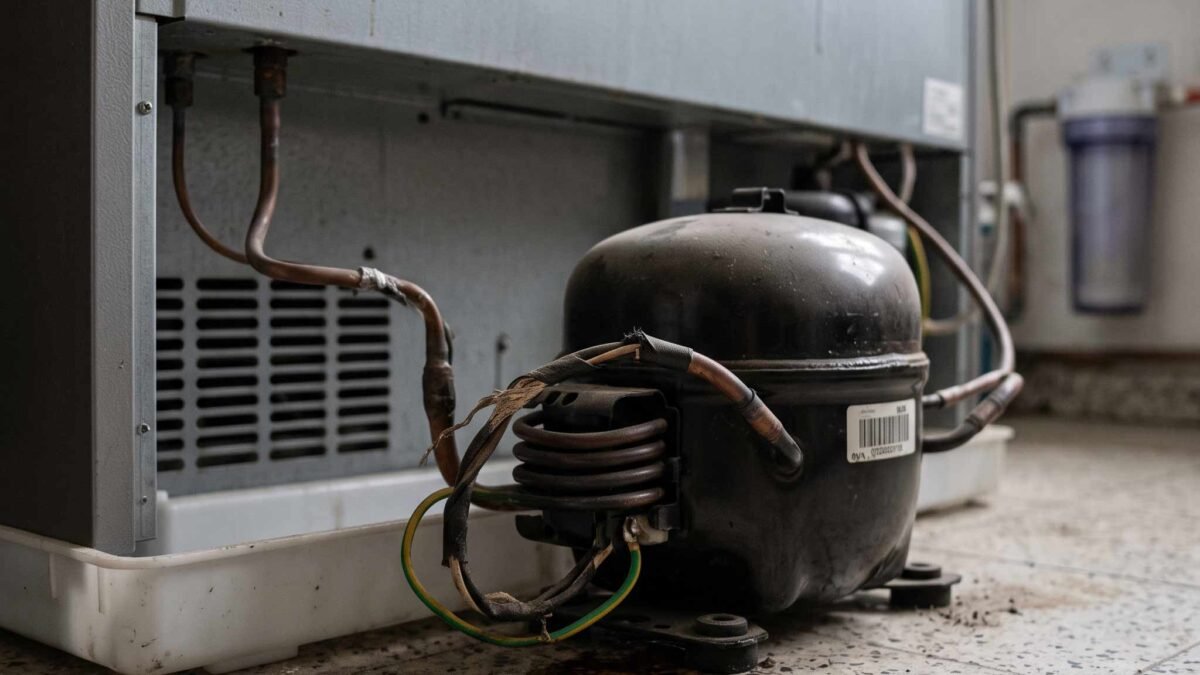
Done this way, a refrigerator gas refilling in Dubai is a one-visit permanent repair. Done the shortcut way — a valve, a can, ten minutes — it is a subscription to the same breakdown, and the compressor often pays the price for the oxygen and moisture that got pumped in alongside the gas.
Refrigerator gas refilling cost in Dubai (2026)
Honest pricing depends on where the leak is and which part of the loop needs work. As a 2026 reference for homes across Dubai:
- Leak detection and diagnosis: AED 100–250, typically waived when you proceed with the repair.
- Accessible joint repair + full recharge: AED 250–450 for a braze-and-recharge on an external joint.
- Evaporator or condenser section repair: AED 400–700 when the leak sits inside the cabinet and part of the foam must be opened and resealed.
- Filter-drier replacement with recharge: AED 250–500.
- Compressor-side valve or process-tube work: AED 300–600 depending on the model.
Be deeply suspicious of anyone quoting a flat “AED 150 gas refill” over the phone. Refrigerant itself is not the expensive part of the job — the equipment, nitrogen, vacuum time, scales and skill are. A price that cheap can only skip the leak hunt, and you already know where that road ends: the same warm fridge, another invoice, a few weeks later. Our full refrigerator repair cost guide for Dubai shows how sealed-system work compares with every other common repair.
There is also a moment when refilling stops making sense at all. If the unit is over eight years old, has already been refilled once, and now needs an internal-section repair, the maths can tip toward replacement — a decision we will tell you honestly, even though it costs us the job. Our repair-or-replace rule of thumb is explained in the cost guide above.
5 red flags when booking a gas refill
- Price quoted before the leak is even diagnosed. Without knowing where the gas escaped, no one can promise a refill will solve anything.
- No vacuum pump or charging scale on the van. Charging by weight and pulling a vacuum are not optional steps — their absence is the tell of a corner-cut refill.
- “Your fridge uses more gas in summer.” Refrigerant is not a consumable and has no seasonal dosage. This line exists to sell repeat visits.
- No paperwork, no warranty. A sealed-system repair without a written warranty is someone refusing to stand behind the leak they claim to have fixed.
- Refilling every few months. One leak repair should end the story. If a “technician” has been back twice for the same refill, the leak was never found.

Frequently asked questions
How much does refrigerator gas refilling in Dubai cost?
Between AED 250 and 600 for a proper job that includes leak repair, vacuum and a weighed recharge. A quoted “top-up only” price under AED 200 almost always skips the leak hunt and fails within weeks.
How long does a gas refill take?
Plan for two to four hours. Leak detection, the repair itself, evacuation and a weighed charge cannot be rushed, and the final run-test needs the unit to reach temperature.
Can I refill the gas myself?
No. Modern fridges use R600a isobutane, which is flammable, and the loop requires brazing, nitrogen and vacuum equipment. Sealed-system work belongs to trained technicians — this is written into safety standards for household refrigerating appliances.
How do I know the gas is actually leaking?
The signature is gradual cooling loss over days or weeks, an uneven frost line on the rear freezer panel, sometimes an oily trace at a pipe joint or a faint hiss after the compressor stops. Sudden total failure is more often electrical than refrigerant.
Is R600a gas dangerous in my kitchen?
Inside the sealed loop it is completely safe, and the charge in a domestic fridge is tiny (30–90 grams). It only becomes a hazard if a large quantity is released near an ignition source — one more reason never to let an unqualified person cut into the system.
How often should refrigerator gas be refilled?
Ideally never. A factory-sealed system holds its charge for decades. A fridge that needs a second refill within a year has an unresolved leak, not a maintenance schedule.
If your fridge is showing the warning signs above, our team repairs sealed systems properly — leak found, leak fixed, charge weighed, result verified, all backed by a written warranty. See the full range of refrigerator repair services in Dubai or book a technician at +971 52 891 1252 — most sealed-system jobs are completed in a single visit anywhere in Dubai.
How to avoid needing a gas refill at all
Because a sealed system has no consumable gas, prevention is genuinely simple — most of the leak causes we listed above are avoidable with habits that cost nothing:
- Never chip ice with metal tools. One slipped screwdriver through an evaporator plate creates the exact failure this article is about. Defrost frost-free freezers by switching them off and letting ice melt.
- Keep the fridge level. A unit leaning on its compressor vibrates its own joints loose over the years. Check with a spirit level after every move and adjust the front feet.
- Move it the right way. Keep a fridge upright during transport and let it rest a few hours before plugging in. Laying it on its side lets compressor oil migrate into places that cause both leaks and valve damage.
- Vacuum the condenser coils twice a year. Dubai dust bakes onto the rear coils; an overheated compressor stresses every joint in the loop. Sixty seconds with a soft brush attachment is the cheapest insurance in appliance care.
- Leave ventilation clearance. Five centimetres minimum behind the cabinet and free airflow over the top. Built-in fridges must follow the manufacturer’s ventilation cut-outs exactly.
- Fix door gaskets early. A tired seal makes the compressor run longer and hotter — and a fridge that “never stops running” is where early sealed-system failures usually begin.
Gas refill or something else? How to tell the difference
Not every warm fridge needs sealed-system work, and diagnosing this correctly is the difference between a small invoice and an unnecessary one. Use this quick sorting logic before you call:
- Freezer frozen solid, fridge section warm: usually an evaporator fan, damper or defrost fault — airflow, not gas. Our refrigerator-not-cooling guide covers the six most likely causes.
- Everything warm, compressor never starts: typically the start relay or thermostat — an electrical repair, cheaper than any sealed-system job.
- Slow decline over weeks plus uneven frost or an oily trace: this is the genuine low-charge signature — book a leak diagnosis.
- Frost spreading thickly across the whole evaporator: a defrost system fault, not a gas issue.
When you describe those symptoms on the phone, a good company can tell you which family the fault belongs to and arrive prepared. For the complete catalogue of faults, our main refrigerator repair guide for Dubai walks through all twelve common problems.
Booking refrigerator gas refilling in Dubai with our team
We handle sealed-system repair on Samsung, LG, Bosch, Siemens, Whirlpool, Electrolux, Hitachi, Nikai and other brands sold in the UAE — single-door, double-door, side-by-side and French-door units. Our technicians arrive with nitrogen, vacuum pumps and charging scales as standard, quote a fixed price before work starts, and back sealed-system repairs with a written warranty.
We cover the whole city — Dubai Marina, JBR, JLT, Business Bay, Downtown, Jumeirah, Al Barsha, Motor City, JVC, Dubai Silicon Oasis, Mirdif, Al Nahda, Al Qusais, Deira, Bur Dubai, Discovery Gardens and Dubai South — with same-day slots for urgent food-safety situations. Call or WhatsApp +971 52 891 1252 with the model number and a one-line description of the symptoms; that alone usually lets us bring the right parts the first time.
Gas Refilling vs. Compressor Replacement: What Your Fridge Actually Needs
Many Dubai homeowners book a refrigerator gas refilling in Dubai when the real problem is a tired compressor — and the opposite happens too. Here is the honest way we separate the two on site. Gas refilling fixes a gas refilling problem: a cooling loss caused by refrigerant escaping through a leak. Compressor replacement fixes a mechanical failure: the pump itself stops compressing. The symptoms overlap, which is why guessing costs money.
A technician who arrives and immediately quotes “full gas charge” without a gauge test is guessing. Proper refrigerator gas refilling always starts with pressure readings on both sides of the system, a leak search, and only then a vacuum and recharge. If the compressor runs but pressures are low and bubbling is audible, refrigerant loss is confirmed. If pressures are normal yet the cabinet stays warm, the fault is elsewhere — airflow, evaporator, or compressor efficiency.
Why repeated gas refilling is a red flag
Refrigerant does not get “used up”. If your unit needed gas refilling six months ago and now cools badly again, the first recharge never fixed the underlying leak, or the leak was never located. Repeated gas refilling without leak repair is money down the drain — and for R600a systems, repeated releases are a safety concern indoors. A correct job includes locating the leak (bubble test, electronic leak detector, or dye), repairing it, pulling a proper vacuum to remove moisture, and then charging to the exact plate-specified weight. Anything less is a temporary patch.
If your fridge is more than ten years old and needs a second recharge within a year, compare the total spend against a replacement unit — the arithmetic usually favors replacing. Our technician will show you the pressure readings and the leak location so you can make that decision with real numbers, not estimates.
Related reading:
• Budgeting for a bigger job? See Refrigerator Repair Cost in Dubai 2026: Best Price Guide.
• Fridge warm but freezer fine? Start with Refrigerator Not Cooling in Dubai? 6 Best Fixes.